Guide Opérationnel 2026
0% Droits de Douane UE via A.TR
5–8 Jours Ouvrés (Route FTL) | 36–48 Heures (Minivan Express)

Guide Complet Étape par Étape : Exporter du Fret de Turquie vers l'Union Européenne

Maîtrisez les 5 étapes clés de la logistique transfrontalière : choix des Incoterms, émission de la lettre de voiture CMR, déclaration en douane BİLGE, certificat A.TR pour 0% de droits de douane, transit Kapıkule vs Ro-Ro et dédouanement final dans l'UE.

Updated October 2026 · Brosan Lojistik Operations Desk

Étapes Totales5 ÉtapesFacture à la Livraison
Transit Moyen5–8 JoursMinivan Express 36–48h
Systèmes DouaniersBİLGE & NCTSMEDOS e-A.TR
Corridors PrincipauxRoute & Ro-RoKapıkule vs Trieste
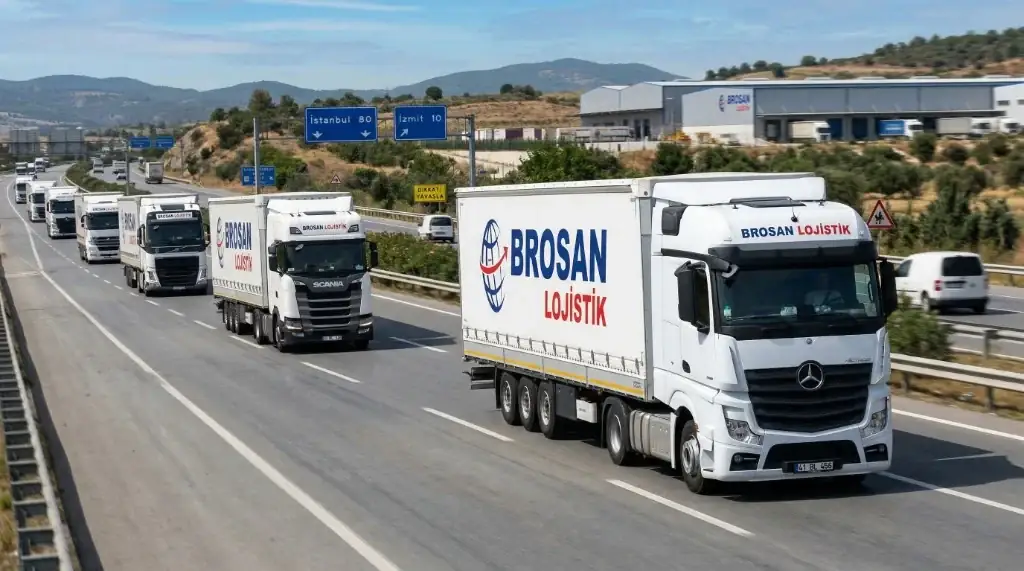
Flotte de camions modernes marquée Brosan Logistics assurant le transport routier international de la Turquie vers l'Europe
Opérations Européennes de Fret RoutierDéparts réguliers FTL & LTL via Kapıkule et Ro-Ro Trieste
0% Droits via A.TR & NCTS T1
Interactive Verification Simulator

Simulateur de Préparation des Documents d'Exportation

Vérifiez vos documents d'expédition pour assurer la conformité douanière avant le départ.

2 sur 7 documents obligatoires vérifiés29%
Facture Commerciale (Commercial Invoice)Step 1

Facture bilingue en EUR avec codes SH à 6-12 chiffres, règle Incoterms 2020 et EORI du destinataire.

Liste de Colisage Export (Packing List)Step 1

Détail des colis, poids net/brut, dimensions et palettes bois conformes au traitement NIMP 15.

Lettre de Voiture Internationale CMRStep 2

Contrat de transport en 4 feuillets avec numéro de scellé haute sécurité ISO 17712 en case 19.

Déclaration Douanière d'Exportation Turque (BİLGE)Step 3

Déclaration électronique enregistrée sous le régime 10 00 avec code-barres de mainlevée.

Certificat de Circulation Électronique A.TR (MEDOS)Step 3

Document officiel visé avec QR code conférant l'exonération totale de droits de douane dans l'UE.

Document de Transit Européen T1 NCTS Phase 5Step 4

Titre de transit avec numéro MRN garanti par la caution financière globale du transporteur.

Preuve de Livraison Sans Réserve (CMR Case 24 POD)Step 5

Date, signature et cachet commercial du destinataire attestant de la bonne réception du fret.

Step 1 of 5Étape 1 : Préparation Commerciale & Réservation1–2 Business Days

Tarification Préalable & Choix de l'Incoterm

La base de toute exportation réussie de Turquie vers l'Europe repose sur la définition claire des obligations selon les Incoterms 2020, l'établissement d'une facture commerciale et d'une liste de colisage rigoureuses, et le calcul précis du poids taxable.

Mandatory Procedural Directions

  1. 1Sélectionnez la règle Incoterms 2020 optimale (privilégiez FCA ou DAP plutôt qu'EXW pour les exportations turques).
  2. 2Émettez une facture commerciale bilingue mentionnant les codes SH à 6-12 chiffres, la devise et le numéro EORI du destinataire.
  3. 3Établissez une liste de colisage détaillée avec poids brut/net et palettes en bois conformes à la norme NIMP 15.
  4. 4Calculez le poids volumétrique sur la base du ratio routier 1:3000 (1 m³ = 333 kg) et des mètres de plancher (LDM).
  5. 5Effectuez la réservation de transport sur Turkey Freight Quote avec les spécifications de votre chargement.

Operational Deep Dive & Sub-Tasks

1.1
Select the Appropriate Incoterms® 2020 Rule

Evaluate EXW vs FCA vs DAP/DDP. Under EXW, foreign buyers cannot easily lodge Turkish customs declarations without a domestic tax ID or power of attorney. FCA (Free Carrier) is strongly recommended for container and truck shipments: the Turkish seller completes export customs and hands cargo over to the buyer's carrier. For delivered freight, DAP (Delivered at Place) is the European standard where the seller handles transport to destination while the buyer clears local EU import customs and pays VAT.

Pro Tip: Avoid EXW for Turkish exports unless your buyer has an established Turkish fiscal representative. FCA gives the seller export proof required by the Turkish Tax Office to claim VAT refund (KDV İadesi).
Pitfall to Avoid: Using FOB for road trucking or container shipping. FOB is strictly maritime; use FCA for truck and containerized intermodal freight.
1.2
Draft Bilingual Commercial Invoice & Verify HS Codes

Prepare the commercial invoice in English (or Turkish/English bilingual). Mandatory fields: Seller and Buyer company names, addresses, tax IDs and Buyer EORI number; Invoice date and unique number; Incoterms 2020 rule with named place (e.g. 'DAP Munich, Germany Incoterms 2020'); 6 to 12-digit HS codes (GTİP); unit quantity, unit price, and currency (EUR/USD); and Bank payment details.

Pro Tip: Ensure your commercial invoice explicitly states the country of origin ('Origin: Turkey') to support subsequent preferential A.TR or EUR.1 certificates.
1.3
Compile Itemized Packing List with ISPM 15 Wood Certification

List carton counts, piece counts, and packaging types per pallet. Clearly tabulate gross weight and net weight per package and total consignment. All solid wood packaging (pallets, crates, dunnage) must bear the IPPC stamp verifying heat treatment under ISPM 15 standards to prevent quarantine rejection at EU borders.

Pitfall to Avoid: Using uncertified or untreated wooden pallets. EU border phytosanitary inspectors at Kapıkule or Trieste will reject untreated timber, resulting in severe delays and costly transloading.
1.4
Calculate Volumetric Weight & Loading Meters (LDM)

Calculate volume in cubic meters (Length × Width × Height in meters). Apply standard international freight conversion ratios: Road freight ratio is 1:3000 (1 CBM = 333 kg; 1 LDM = 1,750 to 1,850 kg). Air freight ratio is 1:6000 (1 CBM = 167 kg). Maritime ratio is 1:1000 (1 CBM = 1,000 kg). Chargeable weight is the higher of actual gross weight or volumetric weight.

Documents d'Exportation Requis

Commercial Invoice (Ticari Fatura)1 Original + 3 Copies

Primary accounting and customs valuation document defining value, currency, and HS code.

Basis: Turkish Tax Procedure Law (VUK) & UCC Article 145
Export Packing List (Çeki Listesi)1 Original + 3 Copies

Detailed packaging breakdown with gross/net weight and pallet dimensions for physical customs inspection.

Basis: Turkish Customs Regulation Article 115
ISPM 15 Wood Packaging CertificateIPPC Heat Treatment Stamp on Pallets

Certifies solid wood packing material is treated against invasive biological pests.

Basis: FAO International Standard for Phytosanitary Measures No. 15

Coûts Réglementaires et de Transit Types

Commercial Documentation & TranslationIn-house or translation agency • Seller (Exporter)
€0 – €50
ISPM 15 Heat-Treated PalletsStandard EPAL Euro pallet pricing • Seller (Exporter)
€12 – €18 / pallet
Conseil d'Expert Dispatcheur Brosan: Vérifiez impérativement le numéro EORI de votre acheteur européen avant le départ. Un EORI invalide bloque la marchandise à la frontière de l'UE.
Erreur Courante à Éviter: Discordance de code SH entre la facture commerciale et la déclaration en douane électronique BİLGE.
Step 2 of 5Étape 2 : Expédition au Départ & Contrat CMR4–8 Hours (Day 1)

Enlèvement de la Marchandise & Émission de la Lettre de Voiture CMR

La prise en charge physique des marchandises par le transporteur international active la responsabilité sous la Convention CMR de l'ONU. Le véhicule doit être inspecté, le poids vérifié sur pont-bascule officiel, les portes sécurisées par scellé boulon ISO 17712 et les 4 exemplaires du CMR signés.

Mandatory Procedural Directions

  1. 1Inspectez le camion international (bâche Code XL tendue, plancher propre, sangles d'arrimage de 500 daN).
  2. 2Répartissez uniformément le fret pour respecter la charge maximale de 40 tonnes sur les essieux.
  3. 3Obtenez le ticket de pesée officiel (tare et poids brut) de la station de pesage.
  4. 4Apposez un scellé de haute sécurité ISO 17712 sur les portes de la remorque ou du conteneur.
  5. 5Remplissez le CMR en 4 exemplaires en indiquant le numéro de scellé dans la case 19/20.

Operational Deep Dive & Sub-Tasks

2.1
Rigorous Pre-Trip Vehicle & Equipment Inspection

Before loading begins, driver and warehouse supervisor inspect the trailer. Ensure EN 12642 Code XL curtainside certification (withstands lateral forces up to 40% of payload without deformation), dry and odor-free wooden/composite floor with minimum 7,200 kg forklift axle rating, certified lashing ratchet straps (EN 12195-2 with minimum 500 daN tension rating), and heavy-duty anti-slip rubber mats.

2.2
Axle Weight Compliance & Load Securing

Distribute pallets longitudinally to maintain axle weight compliance under Turkish and European road laws (maximum 11.5 tonnes on drive axle, 24 tonnes on tri-axle semi-trailer group). Total gross combination weight must not exceed 40.0 tonnes (44.0 tonnes for intermodal container chassis).

Pro Tip: Always secure the final two rows of pallets with cross-strapping (X-lashing) to prevent load shift during emergency braking on European motorways.
2.3
Weighbridge Weighing & Kantar Slip Issuance

Drive to an authorized weighbridge station. Record empty tractor-trailer tare weight and laden gross weight. The official certified weight slip (kantar fişi) must be retained and attached to shipping files.

2.4
ISO 17712 High-Security Bolt Sealing

Close trailer rear doors or container cam handles. Apply an ISO 17712 High-Security (H-rated) steel bolt seal. The unique engraved serial number must be verified and recorded on the CMR note and customs files.

2.5
Issuance & Execution of the UN CMR Consignment Note

Complete the standard 4-copy CMR consignment note: Copy 1 (Red) for Sender, Copy 2 (Blue) for Consignee, Copy 3 (Green) for Carrier, Copy 4 (Black) for Administration. Ensure Box 1 (Sender details), Box 2 (Consignee), Box 16 (Carrier), Box 19/20 (Seal number & special agreements), and Box 22 (Sender stamp and signature) are properly executed. Under CMR Article 23, carrier liability is capped at 8.33 SDR per kilogram (~€10–11/kg).

Pitfall to Avoid: Failing to record the seal serial number in Box 19 of the CMR. If a seal is cut at customs without an official record, the exporter may be held liable for discrepancies.

Documents d'Exportation Requis

CMR Consignment Note (Uluslararası Sevk İrsaliyesi)4-Part Colored Carbon Set (Red, Blue, Green, Black)

Legal contract of international road carriage, proof of receipt, and title documentation.

Basis: UN CMR Convention (Geneva 1956, Protocol 1978)
Weighbridge Weight Slip (Kantar Fişi)2 Copies

Certified proof of tare, gross, and net cargo weight for highway and maritime safety.

Basis: SOLAS VGM / Turkish Highway Traffic Law

Coûts Réglementaires et de Transit Types

Weighbridge Weighing Fee (Kantar)Standard road weighbridge fee • Shared / Incoterm-dependent
€10 – €20
ISO 17712 High-Security Bolt SealProvided by Brosan Lojistik • Carrier / Forwarder
€3 – €8 / seal
Conseil d'Expert Dispatcheur Brosan: Les remorques Euro-6 de Brosan Lojistik intègrent des capteurs d'essieu télématiques alertant le centre opérationnel en cas de surcharge avant la sortie d'Istanbul.
Erreur Courante à Éviter: Laisser partir le chauffeur sans signature de la case 22 du CMR ou omettre le numéro de scellé dans la case 19.
Step 3 of 5Étape 3 : Dédouanement Export en Turquie12–24 Hours (Day 2)

Déclaration en Douane d'Exportation & Émission du Certificat A.TR

La déclaration d'exportation doit être transmise électroniquement au Ministère du Commerce turc via le système BİLGE par un commissionnaire agréé (Gümrük Müşaviri). Simultanément, un certificat de circulation A.TR est émis via TOBB MEDOS garantissant 0% de droits de douane à l'entrée dans l'UE.

Mandatory Procedural Directions

  1. 1Le déclarant en douane enregistre la déclaration sous le régime export 10 00 dans le portail BİLGE.
  2. 2Le système oriente le dossier selon le canal de risque (Vert = validation immédiate, Jaune = contrôle documentaire, Rouge = inspection physique).
  3. 3Génération du certificat électronique A.TR avec code QR sécurisé sur la plateforme MEDOS.
  4. 4Validation conjointe par la Chambre de Commerce et les Douanes turques.
  5. 5Attribution du numéro d'enregistrement officiel et code-barres de sortie ; départ autorisé du camion.

Operational Deep Dive & Sub-Tasks

3.1
Electronic Declaration Submission via BİLGE System

The licensed customs broker logs into the Ministry of Trade's BİLGE system using a secure e-signature and company Power of Attorney (Vekaletname). The broker inputs exporter details, consignee EORI, HS code, cargo value in EUR, currency conversion rate, package marks, vehicle license plate, and border exit gate (e.g. Kapıkule TR220100 or Pendik Ro-Ro TR341300).

3.2
Automated Inspection Line Assignment (Hat Belirleme)

Upon submission, BİLGE's risk engine assigns an inspection channel: Green Line (Yeşil Hat - Immediate clearance for Authorized Economic Operators / YYS holders); Yellow Line (Sarı Hat - Documentary scrutiny of invoice, packing list, and certificates without cargo opening); Red Line (Kırmızı Hat - Physical cargo inspection, seal opening, and container x-ray scanning at customs bonded yard).

Pro Tip: Holders of YYS (Authorized Economic Operator) status benefit from Green Line clearance, clearing export customs in under 30 minutes without stopping at local customs offices.
3.3
MEDOS Electronic A.TR Movement Certificate Generation

Under the EU-Turkey Customs Union (Decision 1/95), industrial goods in free circulation move duty-free (0% basic customs tariff). The broker generates the electronic A.TR certificate through MEDOS (managed by TOBB). The Chamber of Commerce approves the document electronically, and Turkish Customs applies an automated electronic customs endorsement and QR verification code.

Pitfall to Avoid: Confusing A.TR with EUR.1. A.TR proves free circulation status for industrial goods under the EU Customs Union. Agricultural and coal/steel goods require EUR.1, not A.TR. Trade with the UK or Switzerland also requires EUR.1 under separate FTAs.
3.4
Document Cross-Matching & Export Registration

Verify that the HS code, net weight, invoice number, and valuation on the BİLGE declaration match the MEDOS A.TR certificate with absolute precision. Pay mandatory Exporter Association fee (İhracatçı Birlikleri nisbi aidat).

3.5
Customs Registration Approval & Departure Authorization

Customs officer signs off electronically. The declaration receives an official Registration Number (Tescil Numarası). The trailer is cleared to proceed under customs transit to the exit border or Ro-Ro port.

Documents d'Exportation Requis

Export Customs Declaration (Gümrük Beyannamesi)Electronic XML + 1 Printed Copy with Barcode

Official statutory declaration to the Turkish government of goods leaving national customs territory.

Basis: Turkish Customs Law No. 4458 Article 60-70
A.TR Movement Certificate (A.TR Dolaşım Belgesi)Electronic QR-coded Document

Proves free circulation under the EU-Turkey Customs Union, granting 0% customs duty at EU destination.

Basis: Decision No 1/95 of the EC-Turkey Association Council
Customs Power of Attorney (Gümrük Vekaletnamesi)Notarized Original registered in BİLGE

Legal authorization granting the customs broker authority to represent the exporter.

Basis: Turkish Notary Law & Customs Law No. 4458

Coûts Réglementaires et de Transit Types

Customs Brokerage Service Fee (Gümrük Müşavirlik Ücreti)Standard export brokerage tariff • Seller (Exporter)
€75 – €150
MEDOS A.TR Electronic Approval FeeTOBB Chamber document fee • Seller (Exporter)
€35 – €60
Exporter Association Registration (Nisbi Aidat)Statutory union fee • Seller (Exporter)
0.05% – 0.1% of FOB value
Conseil d'Expert Dispatcheur Brosan: Nos commissionnaires en douane sont postés directement aux bureaux d'Erenköy, Muratbey, Ambarlı et Mersin pour traiter sans délai les circuits jaunes et rouges.
Erreur Courante à Éviter: Émettre un certificat A.TR pour le Royaume-Uni ou la Suisse. N'appartenant pas à l'Union Douanière UE-Turquie, ils requièrent un certificat d'origine EUR.1.
Step 4 of 5Étape 4 : Corridor de Transit International3–6 Days (Days 3 to 6)

Transit & Passage Frontière (Route vs Ro-Ro Intermodal)

Le fret transite à travers les territoires sous couvert d'une déclaration de transit T1 NCTS Phase 5 assortie d'une garantie financière globale. L'expéditeur choisit entre la voie routière par Kapıkule et la liaison maritime Ro-Ro vers Trieste ou Toulon.

Mandatory Procedural Directions

  1. 1Émission de la déclaration de transit NCTS Phase 5 avec numéro MRN et cautionnement financier.
  2. 2Choix de l'itinéraire : route directe Kapıkule (72-120h) ou Ro-Ro intermodal Pendik/Yalova ➔ Trieste (-62% de CO2, 5-6 jours).
  3. 3Formalités de sortie du territoire turc à Kapıkule ou embarquement au terminal Ro-Ro.
  4. 4Entrée sur le territoire douanier de l'UE via Kapitan Andreevo (Bulgarie) ou le port de Trieste (Italie).
  5. 5Suivi télématique en temps réel 24/7 avec alertes de géorepérage et enregistrement continu de la chaîne du froid.

Operational Deep Dive & Sub-Tasks

4.1
Lodgement of NCTS Phase 5 T1 Transit Declaration

The freight forwarder lodges an electronic T1 transit declaration into the Common Transit Convention's NCTS Phase 5 system. The T1 is assigned an 18-character Movement Reference Number (MRN) and barcode. The forwarder must provide a comprehensive financial customs guarantee covering EU import duties and VAT throughout transit until destination discharge.

4.2
Corridor Selection: Overland Road vs. Ro-Ro Intermodal

Route Option A (Kapıkule Overland Road): Travels from Istanbul via Edirne to Kapıkule (TR) / Kapitan Andreevo (BG - EU External Border Gate) ➔ Bulgaria ➔ Serbia (or Romania) ➔ Hungary ➔ Central Europe. Transit time: 72–120 hours. Best for high-urgency, express minivan, or regional Balkan cargo. Route Option B (Ro-Ro Intermodal Sea-Bridge): Semi-trailer boards Ro-Ro ferry at Pendik, Yalova, or Çeşme to Port of Trieste (Italy) in 60–65 hours sea transit, transferring onto electric block trains to Munich, Ludwigshafen, Bettembourg, or Rotterdam. Transit time: 5–6 days. Cuts carbon emissions by over 60%, avoids Bulgarian/Serbian road queues, and operates without driver Schengen visa constraints.

Pro Tip: During holiday peaks and seasonal harvest times, Kapıkule truck queues can reach 24 to 48 hours. Shifting non-urgent cargo to Ro-Ro intermodal eliminates queue uncertainty and aligns with EU CBAM carbon reduction goals.
4.3
Border Customs Clearance & Biometric Verification

At Kapıkule or Trieste port gate, customs authorities scan the MRN barcode, inspect vehicle seals against the CMR and T1 declaration, verify driver passports and visas, and conduct random gamma-ray scanner checks.

4.4
24/7 Telematics Tracking & European Driving Hours Compliance

Brosan Lojistik operations monitor the vehicle via GPS telematics. Drivers strictly observe EU Regulation (EC) No 561/2006 (maximum 9 hours daily driving, mandatory 45-minute break every 4.5 hours, 11 hours daily rest). For urgent shipments, double-driver teams operate continuously to maintain 36–48h express minivan transits.

Documents d'Exportation Requis

NCTS T1 Transit Declaration (Transit Refakat Belgesi)Electronic MRN + Transit Accompanying Document (TAD)

Bonded customs document allowing non-cleared cargo to traverse intermediate European countries duty-free.

Basis: Common Transit Convention (CTC) Phase 5
Bilateral Transit Permits (Geçiş Belgesi / Doçola)Original Physical Permit in Vehicle

Authorizes Turkish heavy freight vehicles to traverse transit nations (Bulgaria, Serbia, Hungary, Austria).

Basis: Bilateral Road Transport Agreements & ECMT (UBAK)

Coûts Réglementaires et de Transit Types

NCTS T1 Comprehensive Financial Guarantee FeeCoverage based on cargo duty/VAT value • Shared / Forwarder
€50 – €90 / declaration
Ro-Ro Sea Bridge Freight & Bunkering (if selected)Pendik/Yalova to Trieste vessel passage • Buyer or Seller (Incoterm)
€1,200 – €1,800 / trailer
Conseil d'Expert Dispatcheur Brosan: Toutes les remorques Brosan Lojistik disposent d'un double GPS satellite inviolable et d'enregistreurs de température certifiés GDP pour les produits pharmaceutiques.
Erreur Courante à Éviter: Négliger les pénuries de quotas de permis de transit routier (doçola) en fin d'année vers l'Autriche ou la Hongrie ; privilégiez alors le Ro-Ro.
Step 5 of 5Étape 5 : Dédouanement à Destination & Dernier Kilomètre24–48 Hours (Days 6–7)

Dédouanement Import UE & Livraison Finale

À l'arrivée au bureau de douane de destination ou au terminal agréé, le document T1 est apuré. Le transitaire dépose la déclaration d'importation, présente l'A.TR pour bénéficier de 0% de droits de douane, acquitte la TVA et fait signer la case 24 du CMR attestant de la bonne livraison.

Mandatory Procedural Directions

  1. 1Apurement du document de transit T1 auprès du bureau de douane de destination ou du destinataire agréé.
  2. 2Enregistrement de la déclaration d'importation dans le système national (DELTA en France, ATLAS en Allemagne, etc.).
  3. 3Présentation du certificat A.TR électronique pour exemption totale des droits de douane.
  4. 4Règlement ou autoliquidation de la TVA à l'importation via représentation fiscale.
  5. 5Acheminement de la remorque à l'entrepôt du client, déchargement et signature sans réserve du CMR case 24 (Clean POD).

Operational Deep Dive & Sub-Tasks

5.1
Discharge of T1 Transit Declaration in Destination EU Customs

The truck reports to the destination inland customs office (Zollamt in Germany, Bureau de douane in France) or an authorized consignee facility (Zugelassener Empfänger). The customs officer or authorized forwarder scans the MRN barcode in NCTS, releasing the financial guarantee bond and terminating transit status.

5.2
Electronic Import Declaration & 0% Duty Application via A.TR

The consignee's customs broker files the Single Administrative Document (SAD / IMA) in the national customs system (e.g. ATLAS in Germany, DELTA in France, DMS in the Netherlands). The broker inputs the electronic A.TR certificate number and QR code. Under the EU-Turkey Customs Union, the basic customs tariff is reduced to 0.0%.

Pro Tip: Without a valid A.TR certificate, the EU customs system will automatically apply standard third-country MFN tariffs (ranging from 2.5% to 14% on manufactured goods).
5.3
Destination Import VAT Handling & Fiscal Representation

Import VAT (e.g. 19% in Germany, 20% in France, 21% in Netherlands) must be paid or deferred. For DDP shipments or multi-country distribution, utilize Fiscal Representation (Fiskalvertretung in Germany, Article 23 in the Netherlands) to reverse-charge import VAT directly on the periodic VAT return, avoiding upfront cash outlays.

5.4
Final Mile Delivery & Facility Offloading

The truck arrives at the consignee's receiving dock. Warehouse staff inspect seal integrity against CMR Box 19, cut the ISO 17712 bolt seal, and unload the cargo using dock levelers and forklifts.

5.5
Clean Proof of Delivery (POD) Sign-Off on CMR Box 24

The receiving manager verifies packaging condition and piece counts. Consignee stamps, dates, and signs Box 24 of the CMR note. This constitutes a Clean POD (Proof of Delivery). Under CMR Article 30, any apparent damage or shortage must be immediately noted in Box 24 prior to driver departure. Notice of non-apparent internal damage must be sent in writing within 7 business days.

Pitfall to Avoid: Accepting delivery without checking seal integrity. If a seal is broken without a customs inspection protocol (Befundprüfung), the receiver cannot subsequently prove in-transit theft or damage.

Documents d'Exportation Requis

EU Single Administrative Document (SAD / Einfuhrzollanmeldung)Electronic Customs Release Notification

Statutory EU import customs declaration releasing goods for free circulation in the European Single Market.

Basis: Union Customs Code (Regulation (EU) No 952/2013)
Clean Proof of Delivery (Stamping CMR Box 24)CMR Blue Copy (Consignee) & Green Copy (Carrier Returned to Exporter)

Irrevocable legal evidence of safe cargo receipt in good order and condition.

Basis: UN CMR Convention Article 24 & 30

Coûts Réglementaires et de Transit Types

EU Import Customs Clearance FeeStandard European brokerage entry • Buyer (DAP) / Seller (DDP)
€90 – €180 / entry
EU Import VATReclaimable on local VAT returns • Buyer (DAP) / Seller via Fiscal Rep (DDP)
19% – 25% of CIF value (deferrable)
Conseil d'Expert Dispatcheur Brosan: Brosan Lojistik met à disposition la preuve de livraison numérique (POD) sur son portail client dans les 2 heures suivant le déchargement.
Erreur Courante à Éviter: Signer la case 24 du CMR sans signaler les avaries apparentes ou emballages déchirés ; sans réserve écrite, le transporteur est légalement présumé déchargé de toute responsabilité.
Multimodal Route Evaluation

Matrice Stratégique des Corridors : Route Kapıkule vs Ro-Ro Intermodal vs Fret Aérien

Comparez vitesse, coûts, émissions de CO2 et risques frontaliers entre la Turquie et l'Europe :

Critères d'Évaluation
Corridor Routier Kapıkule (FTL / Minivan)
Ro-Ro Intermodal (Pendik/Yalova ➔ Trieste + Rail)
Fret Aérien Express (IST / SAW Cargo)
Délai de Transit Moyen3–5 jours (FTL) | 36–48h (Minivan Express)5–7 jours (Pendik/Yalova ➔ Trieste + Train)1–2 jours (Vol Cargo Istanbul + dédouanement)
Émissions de CO2e (Well-to-Wheel)0.062 kg CO2e / tonne-km (Flotte Euro 6)0.024 kg CO2e / tonne-km (-61.3% d'émissions)0.602 kg CO2e / tonne-km (intensité carbone élevée)
Risque d'Attente aux FrontièresModéré à Élevé (files d'attente à Kapıkule 12-48h)Nul (départs maritimes réguliers sur créneaux fixes)Nul (acheminement aérien direct)
Contraintes Visas Chauffeurs & PermisNécessite visas Schengen et autorisations bilatéralesRemorques non accompagnées (zéro contrainte de visa)Aucune contrainte chauffeur
Indice de Compétitivité TarifaireCompétitif pour fret industriel à densité moyenne/hauteLe plus économique pour flux réguliers et charges lourdesTarif premium pour urgences automobiles et pharma
Mécanisme d'Exonération DouanièreCertificat de Circulation A.TR (0% droits UE)Certificat de Circulation A.TR (0% droits UE)Certificat de Circulation A.TR (0% droits UE)
Customs & Legal Regulations

Foire Aux Questions Douanières et Opérationnelles

Réponses certifiées aux questions réglementaires pour vos exports Turquie - Union Européenne.

Sous EXW (Départ Usine), l'acheteur étranger est juridiquement tenu d'effectuer le dédouanement export en Turquie, ce qui requiert un numéro fiscal turc ou une procuration notariée souvent source de blocages. Sous FCA (Franco Transporteur), le vendeur turc dédouane la marchandise, récupère le justificatif fiscal de sortie pour son remboursement de TVA (KDV İadesi) et remet le fret au transporteur.

Direct Operational Booking

Prêt à Expédier Votre Fret vers l'Europe ?

Obtenez un devis instantané tout compris avec dédouanement et livraison porte-à-porte.

Demande de cotation rapideÉtape 1 sur 5
Devis écrit : 1 jour ouvré
Support Opérations en Direct
1
1. Mode
2
2. Itinéraire
3
3. Marchandise
4
4. Périmètre de service
5
5. Contact & Devis

1. Sélection du mode de transport

Choisissez le mode d'expédition optimal pour votre fret au départ de Turquie.

Routier FTL (Camion Complet)

Semi-remorques 13,6m & Méga

Plus populaire vers l'UE

Transport direct de porte-à-porte entre la Turquie et l'Europe. Volume 90–100 m³, charge utile jusqu'à 24 500 kg. Option double équipage express.

Transit estimé : 4–6 jours (Express 72h)

Routier LTL (Groupage / Partiel)

Fret palettisé consolidé

Économique

Solution économique en lots partiels avec départs hebdomadaires réguliers depuis Istanbul, Bursa et Izmir vers les hubs européens.

Transit estimé : 6–9 jours

Maritime FCL (Conteneur Complet)

Conteneurs 20', 40' & 40' HC

Grands volumes

Accords d'armateurs directs via les ports d'Ambarlı, Mersin, Aliağa et Gemlik vers les principaux ports mondiaux.

Transit estimé : 7–22 jours

Maritime LCL (Groupage maritime)

Consolidation en conteneur partagé

Couverture mondiale

Expédition de palettes et caisses via consolidation CFS. Payez uniquement pour le volume (CBM) et le poids réel utilisé.

Transit estimé : 12–25 jours

Fret Aérien Express

Vols réguliers & affrètement cargo

Urgent / Rapide

Départs prioritaires depuis le hub d'Istanbul (IST/SAW) pour cargaisons urgentes automobiles, pharmaceutiques et haute valeur.

Transit estimé : 1–3 jours

Dédouanement & Transit

Certificats A.TR, EUR.1 & T1

Douane & A.TR

Formalités douanières coordonnées via des déclarants en douane en Turquie et aux frontières européennes. Déclarations d'exportation, A.TR, EUR.1 et conformité CBAM.

Transit estimé : 24–48 heures

Intermodal Ro-Ro

Pont maritime (Pendik/Toulon/Trieste) + Rail

Écologique & Fiable

Logistique multimodale écologique évitant les congestions des Balkans. Traversée maritime directe vers la France et l'Italie connectée au rail.

Transit estimé : 5–8 jours